For the last few months, we’ve been asked a lot of questions about Chameleon carriers, what they’re all about, what to watch out for, who wins and who loses. So we’ve taken some time to dig into this current problem within our industry, and have prepared a 3 part report on the topic. We hope this answers some of your questions. If you still have questions, please post them on the blog and we’ll do our best to find some answers for you.
Introduction
Commercial trucks move the vast majority of goods that Americans buy, eat, and use every day. Most trucking companies and drivers operate safely and follow the rules. However, a persistent problem known as “chameleon carriers” allows some unsafe companies to avoid accountability, stay on the road, and put the public at risk.
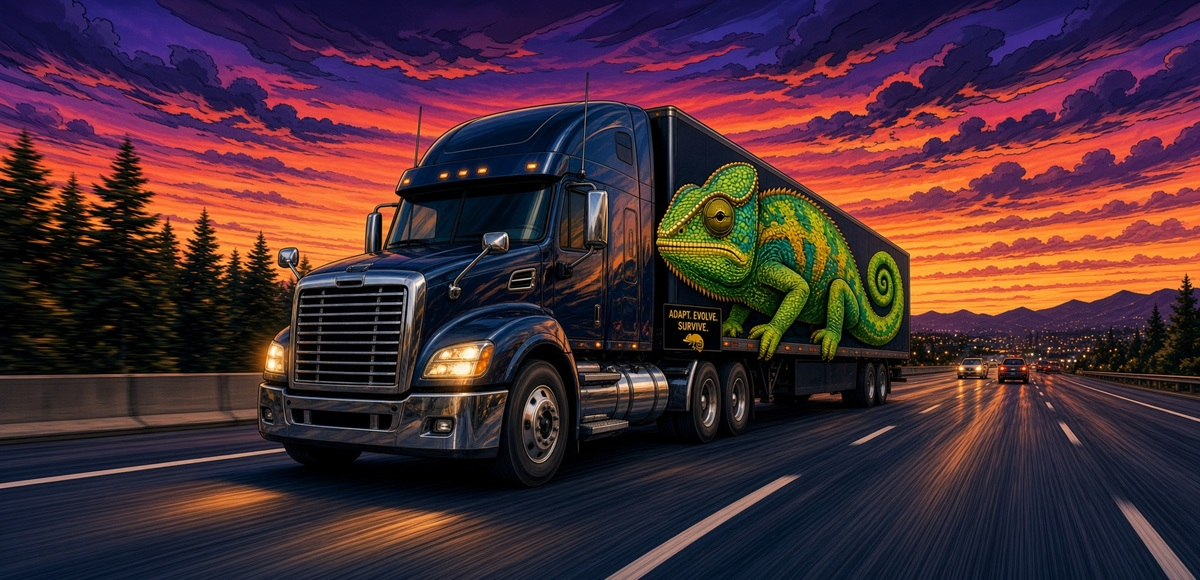
A chameleon carrier is a trucking company that accumulates safety violations, crashes, or enforcement actions, then shuts down and reopens under a new name, new U.S. Department of Transportation (DOT) number, or new ownership structure. The same people, trucks, and drivers often continue operating as if they were a brand-new business. This hides their previous safety record from shippers, insurers, and regulators.
This problem is closely connected to so-called “CDL mills”—low-quality training schools that quickly issue commercial driver’s licenses (CDLs) to people who have received little real instruction and, in many cases, cannot speak or read English. These drivers often end up working for the same chameleon networks.
This post is written for the general public who may not work in transportation every day. It explains the problem in plain language, presents available statistics, and describes recent government actions. The information is drawn from federal data analyses (including CBS News reviews of DOT records), Government Accountability Office (GAO) reports, Federal Motor Carrier Safety Administration (FMCSA) announcements, and industry sources.
Part 1: Training Mills, Scale, and Where the Problem Is Concentrated
What Are CDL Training Mills?
A commercial driver’s license (CDL) is required to operate large trucks. Federal rules require entry-level driver training (ELDT) that covers safety, vehicle inspection, and basic skills. Legitimate schools provide weeks of classroom and behind-the-wheel instruction.
CDL mills are the opposite. They offer minimal or no real training, use unqualified instructors, operate from parking lots or fake addresses, and still certify students so they can obtain a license. Many advertise that students can get a CDL in a matter of days, sometimes without needing to learn English. These schools proliferated after February 2022, when the federal system began allowing training providers to “self-certify” that they met standards with little verification.
There are roughly 2,100 properly state-licensed CDL schools in the United States. At the same time, the federal Training Provider Registry grew to approximately 35,000 self-certified providers. This gap created the opportunity for mills to operate.
How Many Drivers Have Gone Through These Schools, and When Did It Start?
Exact nationwide totals of drivers trained only by mills are not published. However, recent enforcement actions provide a sense of scale:
- More than 7,000 training providers have been removed or flagged from the federal registry.
- After more than 1,400 on-site inspections by hundreds of investigators, notices of proposed removal were issued to over 550 schools.
- An emergency action targeted 110 schools linked to more than 5,000 drivers who were later cited for failing English-language proficiency tests.
The modern surge in mills began after the February 2022 ELDT self-certification rules took effect. Chameleon-carrier tactics themselves are older. The Government Accountability Office documented a rise in carriers with chameleon characteristics from 759 in 2005 to 1,136 in 2010. Formal rules against “reincarnated” carriers date to the early 2010s following deadly crashes.
Which States Have the Highest Numbers of Schools and Problem Licenses?
Recent federal actions have concentrated on several states. In one major round of school actions:
- Texas and Pennsylvania each had 13 physical schools affected.
- California had 11, Florida 10, and Utah 9.
- These five states accounted for roughly two-thirds of the physical locations identified. Additional online-only providers were also targeted.
Non-domiciled CDLs (licenses issued by a state to people who do not live there, often foreign drivers) are also concentrated. Texas has issued tens of thousands over a decade (with several thousand still active). Illinois, Pennsylvania, Florida, and others have seen sharp increases. California has faced repeated federal findings of noncompliance related to these licenses and English proficiency.
Do All States Have Plans to Stop This? Are Any Refusing to Cooperate?
Federal rules apply nationwide, and most states have participated in recent inspections and audits. Cooperation is not uniform. California has been cited repeatedly for compliance problems with non-domiciled CDLs and English-language requirements, and has faced funding consequences. Some states have paused or restricted certain license issuances under federal pressure. Overall, the federal government can and does use oversight and funding leverage when state performance falls short, but local capacity and priorities vary.